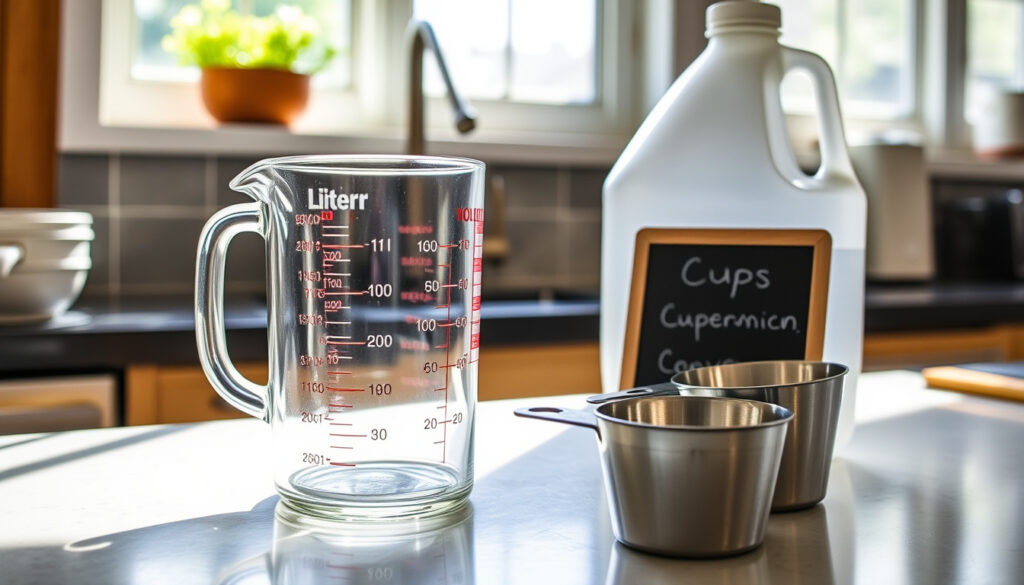
How Many Liters in a – Gallons, Cups, Ounces, and More
Whether you are following a recipe, calculating fuel for a trip, or working on a science experiment, converting between liters and gallons, cups, ounces, or kilograms can quickly become confusing. The key challenge lies in the fact that measurement systems vary, and a “gallon” is not the same size everywhere. This guide provides clear, fact-based answers to the most common questions about how many liters are in different units.
How Many Liters in a Gallon? (US and Imperial)
The most frequent question in volume conversion is also the one most prone to error. The answer depends entirely on whether you are using a US gallon or an Imperial (UK) gallon, which are not the same size.
- 1 US gallon = 3.785 liters (US liquid gallon)
- 1 UK/Imperial gallon = 4.546 liters (Used in UK, Canada, India (legacy))
- 1 US cup = 0.2366 liters (8 fluid ounces)
- 1 liter = 1000 milliliters (Base SI unit)
Several key insights help avoid common mistakes. The most frequent conversion error is confusing US and Imperial gallons, so you must always check regional standards. For water, 1 kilogram equals 1 liter at 4°C, but for oil (0.92 kg/L), 1 kg is approximately 1.087 liters. A standard water bottle is often 0.5 liters (500 ml) or 1 liter in many countries. Finally, fluid ounces and liters can be converted straightforwardly: 1 fl oz = 0.02957 L.
Key Volume Conversion Facts
| Unit | Equivalent in Liters |
|---|---|
| 1 US gallon | 3.78541 liters |
| 1 UK/Imperial gallon | 4.54609 liters |
| 1 US cup | 0.236588 liters |
| 1 liter | 1000 milliliters |
| 1 US fluid ounce | 0.0295735 liters |
| 1 kilogram of water (at standard conditions) | 1 liter |
| 1 US quart | 0.946353 liters |
| 1 US pint | 0.473176 liters |
| 1 UK quart | 1.13652 liters |
| 1 UK pint | 0.568261 liters |
How Many Liters in a Cup and Other Common Kitchen Measurements?
In the kitchen, questions about cups and bottles are some of the most common. The conversion depends on whether you are using US or Imperial definitions, though the metric liter is always the same.
How Many Liters in a US Cup?
A standard US cup holds 8 US fluid ounces, which is equivalent to 0.236588 liters (or about 237 mL). This is the standard cup used in US recipes.
How Many Liters in a Bottle of Water?
Water bottle sizes vary by brand and region. Common sizes include 330 mL (0.33 L), 500 mL (0.5 L), 750 mL (0.75 L), and 1 liter. There is no universal standard, so you should always check the label.
How Many Liters in a Pint?
Similar to gallons, the pint differs between systems. A US pint is 0.473176 liters, while a UK pint is larger at 0.568261 liters.
How Many Liters in a Quart?
A US quart equals 0.946353 liters, very close to a liter itself. A UK quart is 1.13652 liters.
How Many Liters in a Milliliter? (Milliliters to Liters Conversion)
This is the simplest conversion within the metric system. The liter is a base unit, and the milliliter is a subunit.
How Many Milliliters in a Liter?
There are exactly 1000 milliliters in 1 liter. This is a fixed definition within the International System of Units (SI).
Converting Liters to mL and Vice Versa
To convert liters to milliliters, multiply by 1000. To convert milliliters to liters, divide by 1000. For example, 2.5 liters is equal to 2500 mL, and 350 mL is equal to 0.35 liters.
How Many Liters in an Ounce? (Ounces to Liters Conversion)
Converting fluid ounces to liters is a common need when dealing with US customary measurements. The conversion factor is precise.
US Fluid Ounces to Liters
One US fluid ounce is equal to 0.0295735 liters. To convert a number of fluid ounces to liters, multiply the number of ounces by this factor.
How Many Liters in 40 Ounces?
Using the conversion factor, 40 US fluid ounces is equal to approximately 1.18294 liters. This is a standard conversion for many household containers.
How Many Liters in a Kilogram? (Weight to Volume for Water and Oil)
Converting kilograms to liters is different from volume-to-volume conversions because kilograms measure mass, not volume. The result depends on the density of the substance.
1 Kilogram of Water to Liters
For water at standard conditions (around 4°C), the conversion is almost exactly 1:1. Therefore, 1 kilogram of water equals 1 liter.
1 Kilogram of Oil to Liters
Oil is less dense than water. Vegetable oil, for example, has a density of about 0.92 kg per liter. This means 1 kg of vegetable oil is equal to approximately 1.087 liters.
There is no fixed conversion from kilograms to liters without knowing the density of the substance. Formulas always require a density value: Volume (L) = Mass (kg) / Density (kg/L).
Gallon vs. Liter: A Brief History of Measurement
Understanding why these conversions exist helps clarify their importance. Liters are part of the metric system (SI), which is used globally except in the US. Many countries, including India, use both metric and imperial measurements due to historical trade and colonial legacy. Conversion tables and formulas are essential to avoid errors in recipes, fuel economy, and scientific experiments. The US gallon is defined as 231 cubic inches, while the Imperial gallon is defined as 4.54609 liters.
What Is Certain and What Remains Ambiguous in Conversions?
Some conversions are fixed by definition, while others depend on context or conditions.
| Established Information | Uncertainty Factors |
|---|---|
| 1 liter = 1000 ml exactly (SI definition). | Conversions involving weight (kg to liters) depend on density and temperature. |
| 1 US gallon = 3.785411784 liters (exact by definition). | Regional usage of ‘gallon’ may be ambiguous (US vs Imperial). |
| 1 UK gallon = 4.54609 liters (exact by definition). | Standard bottle sizes vary by manufacturer (e.g., 330 ml, 500 ml, 1 L). |
Credible Sources for Volume Conversion Data
For official conversion factors, the National Institute of Standards and Technology (NIST) provides authoritative guidelines for US customary to metric conversions. The International Bureau of Weights and Measures (BIPM) defines the base units of the SI system, including the liter. Historical and legal definitions of units can be found in detailed references such as the Wikipedia page for the litre.
Summary: A Complete Guide to Liters in Gallons, Cups, and More
This guide covers the most common “how many liters in a…” questions, from gallons and cups to ounces and kilograms. The most important takeaway is that while metric conversions like milliliters to liters are fixed, conversions involving gallons or weight require knowing whether you are using the US or Imperial system and the density of the substance. For a deeper dive into these relationships, you can refer to this liters in a gallon conversion guide and this US and Imperial volume conversion chart.
Frequently Asked Questions
How many liters in a pint?
1 US pint = 0.473176 liters; 1 UK pint = 0.568261 liters.
How many liters in a quart?
1 US quart = 0.946353 liters; 1 UK quart = 1.13652 liters.
How many liters in a bottle of water?
Common sizes: 0.33 L, 0.5 L, 0.75 L, 1 L. Always check label.
How many liters in a liter?
1 liter equals exactly 1 liter — it’s the base unit.
How many liters in 1 kg of oil?
Depends on density. Vegetable oil ~0.92 kg/L, so 1 kg ≈ 1.087 liters.
How many milliliters are in a liter?
There are exactly 1000 milliliters in one liter.
How many liters in a US gallon?
One US gallon is equal to 3.78541 liters.
How many liters in a half gallon?
A half US gallon is equal to approximately 1.8927 liters.
How many liters in 40 ounces?
40 US fluid ounces is equal to approximately 1.1829 liters.
More related posts
 Karen Pirie Season 3 – Release Date, Cast & Renewal Status
 Where Is Virgin River Filmed – Complete BC Locations Guide
 Cast of Black Bag – Complete Star Guide and Release Details
 Bournemouth vs Man City – Preview, Lineups and Prediction
 Chris Briney – Age, Height, Parents and Girlfriend Revealed
 What Words Can I Make With These Letters – Free Unscrambler Tools Guide
 4444 Angel Number Meaning – Love, Twin Flame, Career Guide
 Sam Fender Tour 2025 – Dates, Venues and Ticket Guide
