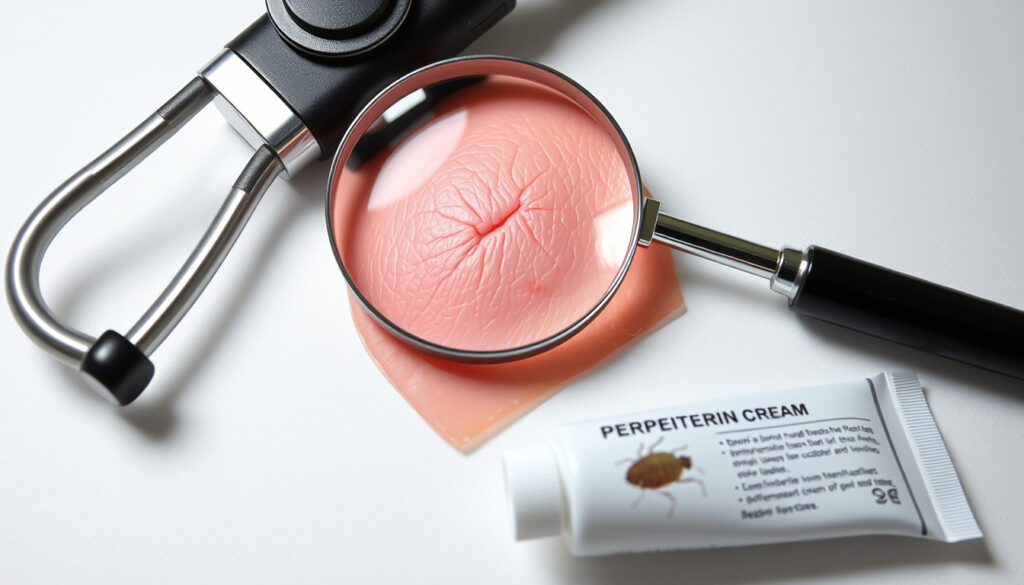
How to Identify Scabies – Key Symptoms and Treatment Guide
Intense itching that worsens at night, a rash with small red bumps, and thin, wavy lines on the skin are the hallmarks of scabies. This contagious skin infestation, caused by the Sarcoptes scabiei mite, is frequently mistaken for eczema or bug bites. Recognizing the distinct signs is the first step toward getting the right treatment and preventing its spread to others.
Scabies is more than just a simple rash. It is caused by a tiny mite that burrows into the upper layer of the skin to live and lay eggs. This triggers an intense allergic reaction, which is why the itching is often so severe. Understanding the specific clues, from burrow patterns to affected locations, can help you distinguish it from other common skin conditions.
The condition spreads primarily through prolonged skin-to-skin contact, making it common among household members and sexual partners. The World Health Organization notes that scabies is a significant public health issue in many parts of the world. While it can be effectively treated, identifying it accurately is essential. For other health concerns, you might find this guide on a Blood Clot in Leg Picture – Key Visual Sign & Symptom helpful.
What Are the Symptoms of Scabies?
Intense itching, worse at night
Tiny red bumps, burrows (silver lines), blisters
Between fingers, wrists, elbows, armpits, waist, genitals
Until 24 hours after first treatment
The classic symptom is severe itching that typically becomes much worse at night. This is often accompanied by a rash that can appear as tiny red bumps, pimple-like lesions, blisters, or scales. According to the World Health Organization, the most telling sign is the burrow.
- Scabies is caused by the human itch mite (Sarcoptes scabiei var. hominis) burrowing into the upper skin layer.
- The classic sign is the ‘burrow’ – a thin, wavy, silver-gray line (1–10 mm) with a tiny dot at the end.
- Symptoms may take 2–6 weeks to appear after first infestation, but only 1–4 days after reinfestation.
- Crusted scabies is a severe form with thick crusts containing thousands of mites, often in immunocompromised people.
- Many skin conditions (eczema, contact dermatitis, bed bugs, folliculitis) mimic scabies, making self-diagnosis risky.
| Attribute | Fact |
|---|---|
| Cause | Sarcoptes scabiei mite (human-specific) |
| Incubation | 2–6 weeks (first time); 1–4 days (reinfestation) |
| Itching | Intense, especially at night, often widespread |
| Burrows | Silver-gray lines, 1–10 mm, with a dark dot at one end |
| Rash type | Pimple-like bumps, vesicles, scaling; often bilateral |
| Common misdiagnoses | Eczema, bed bug bites, contact dermatitis, impetigo |
| When to see a doctor | If rash is persistent, itchy at night, or close contact with infested person |
What Does Scabies Rash Look Like?
The rash often appears as small red bumps that look like pimples, hives, tiny bites, or knots under the skin. The Memorial Sloan Kettering Cancer Center notes that burrows may appear as short, straight or wavy lines. In infants and young children, the rash can be more widespread, affecting the palms, soles, and even the scalp.
What Do Scabies Burrows Look Like?
Burrows are the mite’s tunnels in the top layer of skin. The American Academy of Dermatology describes them as thin, raised, wavy lines or tiny tracks, often with a bump or blister at one end. They are most commonly found in the webs of the fingers, on the wrists, elbows, and armpits. A visible burrow is not always present, so a diagnosis often relies on the pattern of symptoms.
Is Scabies Itchy at Night?
Yes, this is one of the most characteristic features. The itching becomes significantly more intense at night. This is believed to be related to the mite’s activity cycles and the body’s allergic reaction to the mites, their eggs, and their waste.
How to Identify Scabies at Home
At-home identification relies on pattern recognition. The strongest clues are itching that worsens at night, similar itching in other household members, and a rash located in classic areas. Look for the thin, wavy burrow lines, especially between the fingers. The American Academy of Dermatology emphasizes that seeing burrows is a strong indicator.
However, home diagnosis has limitations. Burrows may be scratched away or difficult to see. Definitive confirmation requires a clinician to examine the skin, often using a dermatoscope or a microscopy test of a skin scraping.
Home identification without a microscope has high false-positive and false-negative rates. A rash alone cannot differentiate scabies from many other pruritic conditions.
What Can Be Mistaken for Scabies?
Several conditions look very similar. Eczema (atopic dermatitis) causes itchy, scaly patches but lacks burrows and does not typically spread among close contacts. Bed bug bites cause itchy welts on exposed skin, but the bugs do not live on the body or create burrow lines. Contact dermatitis, folliculitis, and impetigo are other common lookalikes.
How Is Scabies Diagnosed by a Doctor?
A clinician often diagnoses scabies by examining the skin for burrows and the characteristic rash pattern. If confirmation is needed, they may perform a skin scraping test. This involves gently scraping the skin at a suspected burrow and looking for mites, eggs, or mite feces under a microscope.
How to Treat Scabies Effectively
The standard first-line treatment is a prescription cream containing permethrin 5%. It is applied to the entire body from the neck down and left on for 8-14 hours before washing off. Other topical options include malathion, benzyl benzoate, and sulfur preparations. WebMD notes that some cases may require oral medication like ivermectin.
It is crucial to treat all household members and close sexual contacts at the same time, even if they have no symptoms. This prevents reinfestation. All bedding, clothing, and towels must be washed in hot water (at least 50°C) and dried on high heat.
Itching can persist for 2 to 4 weeks after the mites are killed. This is an allergic reaction to the dead mites and does not mean the treatment failed. New burrows appearing after treatment indicate failure or reinfestation.
How to Get Rid of Scabies Quickly?
While no remedy kills mites in 24 hours, prompt treatment stops the contagious cycle. Apply the prescribed cream exactly as directed and follow the cleaning protocol for your environment. The Mayo Clinic advises that avoiding skin-to-skin contact until 24 hours after the first treatment is key to preventing its spread.
What Is Crusted Scabies?
Crusted scabies, formerly known as Norwegian scabies, is a rare but severe form of the infestation. It occurs most often in people with weakened immune systems, the elderly, or those with conditions that affect sensation. Unlike typical scabies, it can present with little to no itching.
What Does Crusted Scabies Look Like?
Instead of a bumpy rash, crusted scabies appears as thick, grayish, dry, scaly crusts or plaques on the skin. These crusts often form on the hands, feet, elbows, and scalp. Because it can contain thousands of mites, it is highly contagious and can spread through casual contact or contaminated items like bedding.
If you see dry, thick crusts on the skin without the classic intense itch, especially in a person with a compromised immune system, crusted scabies should be considered. Treatment is more aggressive and often involves a combination of a scabicide and keratolytic agents to reduce the thick crust.
Timeline of Scabies Progression
Understanding the timeline helps clarify why symptoms appear when they do and what to expect during treatment.
- Day 0: Mite burrows into skin; starts laying eggs.
- Days 1–3: Eggs hatch; larvae migrate to skin surface.
- Days 4–10: Mites mature; itching may begin (mild or absent in first infestation).
- Days 14–42 (first infestation): Immune reaction triggers intense itching and rash; burrows become visible.
- Days 1–4 (reinfestation): Rapid itchy rash due to prior sensitization.
- After treatment: Itching may persist 2–4 weeks (even after mites are dead) due to allergic reaction; new burrows indicate failure or reinfestation.
Certainty vs. Uncertainty in Scabies Identification
It is helpful to know which aspects of identification are firm and which are not. This table breaks down the established facts versus what remains unclear.
| Established Information | Information That Remains Unclear |
|---|---|
| Scabies mites can only be confirmed by skin scraping and microscopic examination. | Burrows may be absent in clean/scratched skin, making visual diagnosis difficult. |
| Burrows are pathognomonic (diagnostic) when present. | Rash alone cannot differentiate scabies from many other pruritic conditions. |
| Intense itching, especially at night, is a hallmark symptom. | Home identification (without a microscope) has high false-positive/false-negative rates. |
| Close contact (skin-to-skin) is the primary transmission route. | Crusted scabies may present without itching and with crusts that look like psoriasis or eczema. |
Why Scabies Is Frequently Misdiagnosed
Several factors contribute to misdiagnosis. The rash has significant overlap with eczema and contact dermatitis, as both cause itchy red bumps. The lack of visible burrows in many cases relies on the patient’s history. Furthermore, nocturnal itching is a non-specific symptom that occurs in many skin conditions. Health care workers may also miss crusted scabies if they are only looking for the typical rash pattern. The mites themselves are barely visible to the naked eye, measuring only 0.2–0.4 mm.
Authoritative Sources on Scabies Identification
Credible medical institutions provide the following guidance on scabies identification:
“The symptoms of scabies are intense itching, especially at night, and a pimple-like rash. You may also see tiny burrows – thin, wavy lines on the skin.”
— NHS (UK)
“In adults and older children, the scabies rash often looks like tiny red bumps that are similar to small insect bites. In infants, the rash can be more widespread and include blisters.”
“The scabies mites burrow into the skin in these areas to lay their eggs, leaving tiny spots and silver-coloured lines, called burrows, on the skin.”
What to Do After Identifying Possible Scabies
If you suspect scabies based on the signs described above, the next step is to see a healthcare provider for a proper evaluation. A definitive diagnosis is important before starting treatment. After confirmation, follow the treatment plan meticulously, including treating all contacts and decontaminating your environment. You may also find this guide on How to Get Rid of an Ingrown Toenail Overnight – Proven Home Remedies useful for other skin-related issues.
Frequently Asked Questions About Scabies Identification
How do you get scabies?
Scabies is spread by prolonged skin-to-skin contact with an infested person. It can also be transmitted through infested bedding or clothing, but this is less common.
Is scabies contagious?
Yes, scabies is highly contagious until 24 hours after the first successful treatment. Crusted scabies is even more contagious.
How long does scabies last?
Without treatment, scabies can persist indefinitely as mites continue to reproduce. With proper treatment, mites are killed within 24 hours, but itching and rash may last 2–4 weeks.
How to prevent scabies spread?
Treat all close contacts simultaneously. Wash all linens and clothing in hot water. Vacuum floors and furniture. Avoid shared bedding/towels until treatment is complete.
Can you see scabies mites with the naked eye?
Adult mites are about the size of a pinhead (0.2–0.4 mm) and extremely difficult to see without magnification. Burrows are more visible as thin silver lines.
What does crusted scabies look like?
Crusted scabies appears as thick, grayish crusts or plaques on the skin, often on hands, feet, scalp, and elbows. Itching may be minimal despite thousands of mites.
More related posts
 Lebron James – Career Stats Net Worth and Legacy 2025
 Can Dogs Eat Pears – Safe Feeding and Risks Guide
 Ellie Goulding – Using Nelko Label Makers for Organization
 Ross County vs Motherwell – H2H Stats and Match Preview
 Attila Hun – Biography, Death and Legacy of the Scourge of God
 Toy Store Near Me – UK Chains Locations & Opening Times
 Amy Lynn Bradley – Disappearance and New Leads in 2025
 Luke Littler Next Match – Date, Time, Opponent and TV Guide
