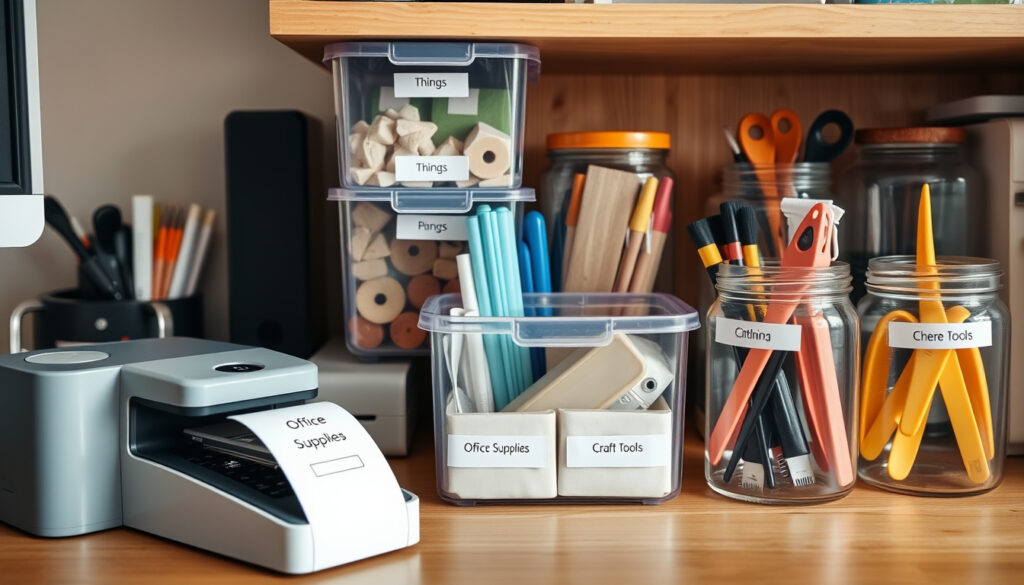
Ellie Goulding – Using Nelko Label Makers for Organization
What Are Nelko Portable Bluetooth Label Makers and Who Are They For?
Nelko’s compact Bluetooth label makers—especially the P21 and PM220—are phone-driven, inkless thermal printers aimed at home organization, students, small businesses, and crafters, with iOS/Android app control and no need for ink or toner.
These devices are part of a growing category of pocket-sized tools that replace the bulk and complexity of traditional label makers. Instead of a standalone keyboard and proprietary cartridges, they rely on a smartphone app to design and send labels wirelessly. The result is a simpler, more portable approach to labeling that fits into a drawer or a bag.
The “Nelko Norve” name appears to be a mix-up rather than a distinct product line in the results. The actual devices from the brand are the P21, PM220, and PL70E, each serving a different purpose. While the P21 and PM220 are designed for casual, everyday labeling, the PL70E is a larger shipping-label printer built for higher-volume tasks.
Connects directly to a phone via the Nelko app, no cables required.
Prints using heat, so there is no ink or toner to replace.
Small enough for a bag, desk drawer, or even a large pocket.
Design labels, QR codes, barcodes, and text from a phone.
Key Insights at a Glance
- Thermal printing eliminates the ongoing cost and hassle of ink or toner.
- The P21 is phone-only and does not work with computers.
- The PM220 supports label widths between 23 and 54 mm, offering more flexibility than the P21.
- An Android 14 compatibility warning exists specifically for Google phones on the P21 listing.
- These devices are best for short, organization-style labels rather than high-volume shipping.
- The PL70E is the brand’s dedicated shipping-label printer, not a pocket model.
Key Facts About Nelko Label Makers
| Feature | Nelko P21 | Nelko PM220 | Nelko PL70E |
|---|---|---|---|
| Printing Technology | Direct thermal | Direct thermal | Direct thermal |
| Connectivity | Bluetooth (phone only) | Bluetooth | Bluetooth |
| Label Width | Compact, portable size | 23–54 mm | 100 × 150 mm |
| Primary Use Case | Organization, crafts, notes | Small business, organization | Shipping and fulfillment |
| Ink or Toner | None | None | None |
| Mobile App | Yes (iOS/Android) | Yes | Yes |
| Computer Support | No | Limited | Yes |
| Target User | Students, organizers | Small business, crafters | Shipping operations |
How Do the Nelko P21 and PM220 Work in Practice?
Using a Nelko portable label maker starts with installing the app. The Nelko app is available on the App Store and requires iOS 13.0 or later. From there, the user loads the paper roll, pairs the printer via Bluetooth, and selects a template from the app’s library. The app supports text, images, QR codes, barcodes, and timestamps, giving it a range of utility beyond just simple name tags.
Product listings note that the P21 works with both iOS and Android via Bluetooth, but one listing warns that it is not compatible with Google phones running Android 14. This is a quirk that may affect a specific group of users, but for most, the setup is straightforward.
The P21 is entirely dependent on the phone app. If the app crashes, loses connection, or the phone model has a compatibility issue, the printer cannot be used. This is not a device with a standalone keyboard or screen.
Design and Portability
The P21 is explicitly described as pocket-sized, making it a strong candidate for carrying in a bag or keeping in a desk drawer for quick tasks. Reviewers at MyMyPC highlight its utility for labeling cables, notebooks, and storage bins. The compact form factor is a core selling point, especially for students and home organizers who do not want a bulky device taking up permanent space on a desk.
The PM220, by contrast, supports a wider label width range of 23 to 54 mm, making it slightly more versatile for small business owners who need to print slightly larger labels, such as address labels or small product tags. Its design still emphasizes portability, but it offers more flexibility in label size than the P21.
Label Quality and Output
Both devices use direct thermal printing, which means the print is black only. This is a fundamental characteristic of the technology and not a limitation specific to Nelko. The output quality is acceptable for organization tasks, but it is not designed for high-resolution color printing. For that, users would need a different type of printer entirely.
One review at TechWalls notes that the adhesive on the labels is firm and that the print quality is clear for text and simple graphics. The main limitation is that the output is monochrome, which may be a dealbreaker for someone expecting vibrant color labels.
Who Should Choose the Nelko P21 or PM220?
The strongest use case for these devices is everyday organization. Students can print labels for notebooks, folders, cables, and dorm storage. Home organizers can use them to sort pantry bins, storage boxes, drawers, and household items. Crafters can create custom stickers, small-batch labels, and quick designs directly from their phone.
For small business owners, the P21 and PM220 work well for simple product labels, inventory tags, and light office organization. However, for high-volume shipping operations, they are less ideal. A dedicated shipping printer like the Nelko PL70E is better suited for handling 100 × 150 mm shipping labels and larger print volumes.
The PL70E is a different class of device. It is designed for shipping labels, not pocket portability. Users who need to print postage or shipping labels regularly should look at the PL70E, not the P21 or PM220.
Comparison With Alternatives
Compared to Brother-style label makers, Nelko’s devices are often cheaper and more app-centric. Brother products, however, tend to offer better standalone hardware, wider enterprise support, and in some categories, higher print resolution. The choice often comes down to whether the buyer prefers a phone-driven workflow or a dedicated hardware interface.
For shipping-focused needs, brands like Rollo, Zebra, and Dymo are generally stronger for high-volume logistics. Nelko’s P21 and PM220 are not designed to compete in that space. They are portable, casual-use-oriented tools that fit a different niche entirely.
Other Bluetooth mini label makers exist, and Nelko is competitive on price and portability. However, the phone-only operation and compatibility quirks, like the Android 14 warning, may lead some users to prefer brands with broader ecosystem support or fewer caveats.
Timeline: From Unboxing to Everyday Use
The experience of owning a Nelko P21 or PM220 follows a predictable sequence that most users will encounter. Below is a typical timeline based on product listings and user reports.
- Unboxing: The device arrives with a starter roll of labels and a USB charging cable.
- App Install: The user downloads the Nelko app from the App Store or Google Play Store.
- Charging: The printer is charged via USB-C or Micro-USB, depending on the model.
- Pairing: The phone connects to the printer via Bluetooth through the app.
- First Print: The user selects a template, inputs text, and prints a test label.
- Daily Use: The printer is used for organization tasks, crafts, or small business labels.
- Refills: The user purchases compatible thermal label rolls, which are widely available.
What Is Certain and What Remains Unclear About the Nelko Norve?
There is a degree of ambiguity surrounding the name “Nelko Norve.” It appears to be a mislabeling or mix-up rather than a clearly distinct product line. The actual devices manufactured by Nelko are the P21, PM220, and PL70E. The “Norve” label does not appear in any official product listing, so it is likely a term that has entered circulation through third-party sellers, reviews, or a misreading of a product name.
| Established Information | Information That Remains Unclear |
|---|---|
| Nelko makes the P21, PM220, and PL70E. | Whether “Nelko Norve” is a real product or a naming error. |
| The P21 is phone-only and does not work with computers. | What exact label sizes are supported by each model beyond the PM220’s 23–54 mm. |
| The app requires iOS 13.0 or later. | Whether Android 14 compatibility issues affect all models or just the P21. |
| Both devices use direct thermal printing, so no ink or toner is needed. | How the print quality holds up over time compared to more expensive thermal printers. |
The Android 14 compatibility warning is specific to the P21 listing and may not apply to other devices in the lineup. This is a notable point for potential buyers who use Google-branded phones.
Another area of uncertainty is the extent to which the PM220 can serve business functions. While it can print barcodes and QR codes, it is not a replacement for a dedicated shipping label printer. The distinction between a label maker and a shipping printer is important for small business owners to understand before making a purchase.
Why Do These Devices Matter for Modern Organization?
In a world where smartphones have replaced many dedicated gadgets, the label maker is a natural candidate for disruption. Traditional label makers are often bulky, require proprietary cartridges, and frustrate users with complex menus. Nelko’s approach is different: it leverages the phone’s processing power, a simple app interface, and the cost-effectiveness of thermal printing.
For students and home organizers, this means less money spent on supplies and less time fiddling with settings. The ability to create a label, QR code, or barcode in seconds from a phone is a genuine convenience. For crafters, the P21 and PM220 enable creative projects like custom stickers and small-batch labels without the need for a full-scale home printer.
The Nelko P21 is often highlighted for its pocket-friendly design, making it a favorite among students and organizers who want to keep one in a bag. The Nelko PM220 Bluetooth label printer offers a bit more flexibility with its wider label support, making it a better fit for small business owners who need to print slightly larger labels for products or inventory.
However, the phone-only nature of these devices is a double-edged sword. While it simplifies the hardware, it also means that if the app stops being maintained or the user’s phone is too new or too old, the device could become obsolete. This is a common concern with app-dependent hardware and one that potential buyers should weigh.
Ultimately, the decision comes down to whether the buyer values portability, low cost, and convenience over raw power and ecosystem compatibility. For the intended audience, which is students, home organizers, crafters, and light small-business users, the trade-offs are often worth it.
“The Nelko P21 is a solid entry point for anyone who wants to print labels without dealing with ink. It is simple, portable, and does exactly what it promises for everyday tasks.”
— Based on user experiences at MyMyPC
What Do Reviews and Listings Reveal About the Product’s Credibility?
Most product listings and third-party reviews are consistent in their assessment of Nelko’s portable label makers. They are praised for being affordable, easy to use, and convenient for their intended purpose. The main criticisms revolve around the lack of computer support for the P21 and the black-only output, which is a limitation of the thermal printing technology itself.
The TechWalls review highlights the device’s portability and the clarity of the print output for text-based labels, which is useful for organization. The manual provided via Manuals Plus offers detailed setup instructions, and it generally reflects a user-friendly experience.
It’s important for consumers to verify the specific features of the model they are buying, as naming inconsistencies like “Nelko Norve” can create confusion. Checking the official Nelko label printer collection is the best way to confirm actual product availability and specifications.
Summary
Nelko’s portable Bluetooth label makers, particularly the P21 and PM220, offer a lightweight, inkless way to handle everyday labeling tasks. They are well-suited for students, home organizers, crafters, and small business owners who need speed and portability. “Nelko Norve” appears to be a naming error, but the underlying devices are real and functional. The main limitation is their focus on phone-controlled, black-only printing, which may not suit high-volume shipping or users who prefer a standalone device. For the target audience, these devices deliver genuine value.
More related posts
 Poached Egg in Microwave – Fast Safe Guide
 New York Times Crossword – Free Play, Difficulty and History
 Millie Bobby Brown Wedding – Date, Tuscany Photos, Full Details
 Arsenal W.F.C. vs FC Barcelona Femení – Complete Head-to-Head Record and 2025 Final Recap
 Wrexham vs Nottingham Forest – Score, Highlights & Report
 Stone Island New Balance – 574 Ghost Spring 2026 Details
 Amy Lynn Bradley – Disappearance and New Leads in 2025
 Cast of the Pale Blue Eye – Complete Cast and Character Guide
