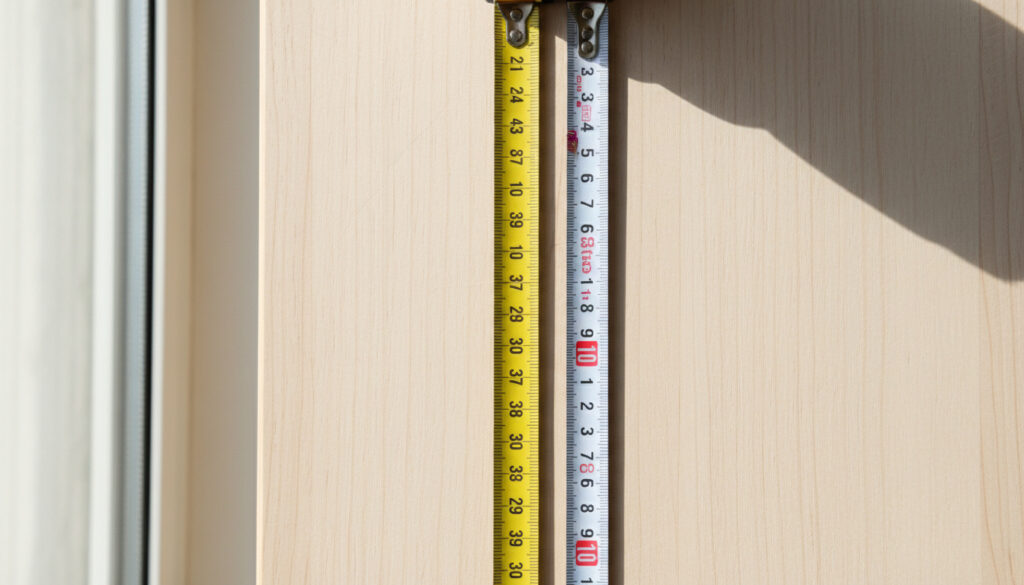
1.85 m Height in Feet – Precise Conversion Guide
One point eight five meters translates to precisely six feet and 0.83 inches in imperial measurements. This conversion places the measurement just above the six-foot threshold commonly used in height descriptions for athletic rosters, medical records, and international travel documentation.
The calculation relies on the international agreement defining one meter as exactly 3.280839895 feet. Multiplying 1.85 by this conversion factor yields 6.069554 feet, which separates into six whole feet plus a decimal remainder convertible to inches.
Standing at 1.85 meters places an individual taller than approximately eighty-five percent of adult males in the United States and roughly eight percent above the global male average height.
How Many Feet is 1.85 Meters?
The direct conversion of 1.85 meters equals 6.069554 feet before rounding, commonly presented as 6.07 feet for practical use. This figure derives from the international standardization of the foot unit established in 1959.
Key Conversion Insights
- The multiplication factor 3.280839895 represents the exact feet-per-meter ratio
- Raw calculation produces 6.069554 feet before rounding protocols apply
- Decimal isolation yields 0.83 inches when multiplied by twelve
- Vertical measurement totals 72.835 inches from ground to crown
- Height exceeds the 85th percentile for American adult males
- Measurement stands 8.2 percent taller than the global male mean of 1.71 meters
- Common specification for professional basketball point guards and shooting guards
Complete Unit Breakdown
| Unit | Value | Context |
|---|---|---|
| Meters | 1.85 | Base metric unit |
| Centimeters | 185 | Clinical measurement |
| Millimeters | 1850 | Precise engineering |
| Feet (decimal) | 6.07 | Standard conversion |
| Feet & Inches | 6′ 0.83″ | Imperial height format |
| Total Inches | 72.83 | Single unit equivalent |
| Yards | 2.02 | Approximate |
| vs Global Average | +8.2% | Compared to 1.71m |
| vs US Average | +5.7% | Compared to 1.75m |
| US Male Percentile | ~85th | Statistical standing |
1.85 Meters to Feet and Inches
Breaking down the decimal portion of the conversion reveals the precise imperial measurement. The 0.069554 remainder after extracting six whole feet converts to 0.83 inches, resulting in a final expression of six feet and roughly five-sixths of one inch.
Begin with 6.069554 total feet. Subtract the integer six, leaving 0.069554. Multiply this decimal by twelve inches per foot to obtain 0.834648 inches, which rounds to 0.83 inches for reporting purposes.
The Decimal Breakdown
The full conversion yields 6.069554 feet. Society typically expresses height using whole feet plus remaining inches rather than decimal feet. This requires separating the integer from the fraction, then converting that fraction to the smaller unit.
The international inch equals exactly 25.4 millimeters since the 1959 international yard and pound agreement. One meter contains 1000 millimeters, thus 1000 divided by 25.4 produces 39.37007874 inches. Divided by twelve, this establishes the 3.28084 feet conversion factor used universally today.
Practical Measurement Precision
For everyday purposes, expressing 1.85 meters as six feet one inch provides sufficient accuracy. However, for medical anthropometry or athletic Combine measurements, the precise 0.83 inch figure matters for percentile rankings and equipment fitting.
How to Convert Meters to Feet (1.85m Example)
Manual conversion requires only multiplication and division operations. The standard formula multiplies the meter value by 3.28084, then separates the result into feet and inches components.
The Standard Formula
Feet equals meters multiplied by 3.280839895. For 1.85 meters, this calculation appears as 1.85 × 3.280839895 = 6.069553 feet. Online calculators automate this arithmetic but follow identical mathematical steps.
Step-by-Step Calculation
First, multiply 1.85 by 3.28084 to yield 6.069554. Second, identify the whole number six as the feet component. Third, subtract six from 6.069554 to isolate 0.069554. Fourth, multiply 0.069554 by twelve to determine the remaining 0.83 inches. When documenting calculations digitally, How to Take a Screenshot on Windows – 6 Easy Methods provides methods for preserving your work.
Verification Techniques
Reverse the calculation by converting the result back to meters. Six feet equals 1.8288 meters exactly. Add 0.83 inches multiplied by 0.0254 meters per inch (0.021082 meters) to obtain 1.849882 meters, confirming the original 1.85-meter value within rounding tolerance.
Is 1.85m Considered Tall?
Statistically, 1.85 meters represents an above-average stature for men across most global populations. Converted to imperial, this height exceeds the average American male by approximately 3.5 centimeters and surpasses the global average by nearly fourteen centimeters.
Regional Height Comparisons
In the United States, where the mean male height approximates 1.75 meters, an individual measuring 1.85 meters stands taller than roughly eighty-five percent of the adult male population. Northern European nations report higher averages, particularly the Netherlands where the mean approaches 1.83 meters, placing 1.85 meters only slightly above average in that specific region.
Professional Contexts
This measurement appears frequently among professional basketball players, though typically as a baseline for guard positions rather than forward or center roles. In modeling industries, particularly for male runway work, 1.85 meters often serves as a minimum threshold requirement. Understanding the imperial equivalent of 1.85 meters proves essential when interpreting international height charts, selecting clothing sizes across different sizing systems, or comparing athletic statistics between metric and imperial reporting systems, and for further details on converting measurements, please see this multiply fractions.
Evolution of Measurement Standards
- : The international yard and pound agreement establishes the inch as exactly 25.4 millimeters, fixing the modern foot at 0.3048 meters precisely.
- : The United States Survey Foot, defined as 1200/3937 meters, remains in limited use for land surveying and property mapping applications.
- : NIST officially deprecates the Survey Foot for most applications, mandating the International Foot to reduce engineering confusion.
- : All height conversions, medical measurements, and commercial applications utilize the International Foot factor of 3.28084 feet per meter exclusively.
Established Standards vs. Historical Variations
| International Foot (Current Standard) | U.S. Survey Foot (Historical) |
|---|---|
| Defined as exactly 0.3048 meters | Defined as 1200/3937 meters (~0.30480061 meters) |
| Conversion factor: 3.280839895 feet per meter | Conversion factor: ~3.280833333 feet per meter |
| 1.85m equals 6.069554 feet | 1.85m equals ~6.069462 feet |
| Difference from Survey Foot: 0.000092 feet (1.1 millimeters) | Difference from International: -0.000092 feet |
| Mandatory for all height, medical, and commercial use | Phased out by NIST in 2022; irrelevant for human height |
Practical and Demographic Context
Understanding the imperial equivalent of 1.85 meters proves essential when interpreting international height charts, selecting clothing sizes across different sizing systems, or comparing athletic statistics between metric and imperial reporting systems. The measurement sits at a psychological threshold, crossing into the category broadly perceived as “tall” in Western contexts while remaining within normal variation for healthy adults.
Population health studies utilize this specific measurement as a reference point for growth chart percentiles, particularly in tracking adolescent development where crossing the 1.85-meter threshold often signals completion of major growth phases in males.
Measurement Authority and Standards
The National Institute of Standards and Technology maintains the definitive specifications for unit conversions within the United States. Their revised conversion factors published in 2022 clarified that the International Foot serves as the sole legal standard for all applications except legacy surveying data.
The international foot, defined as exactly 0.3048 meters, derives from the 1959 agreement establishing the inch at 25.4 millimeters exactly.
NIST Length Standards Documentation
Converting 1.85 Meters Accurately
The conversion of 1.85 meters to feet yields exactly 6.069554 feet, expressed practically as six feet and 0.83 inches. This height measurement exceeds average male stature globally and places individuals in the 85th percentile for height in the United States. For further calculations regarding financial measurements and budgeting ratios, see How Much Mortgage Can I Afford – 28/36 Rule and Salary Guide.
Common Questions
What is the exact formula for converting meters to feet?
Multiply the meter value by 3.280839895. For 1.85 meters, this calculation yields 6.069554 feet exactly.
Does the United Kingdom use a different foot measurement than the United States?
Both nations use the International Foot defined as exactly 0.3048 meters. The US previously maintained a Survey Foot for mapping, phased out in 2022.
How many total inches equal 1.85 meters?
One point eight five meters equals 72.835 inches exactly, derived from multiplying 1.85 by 39.37007874 inches per meter.
What height percentile represents 1.85 meters for men?
Standing at six feet zero point eight three inches places an American male in approximately the 85th percentile for adult height.
Is 1.85 meters considered tall for women?
Yes. The global average female height approximates 1.62 meters, making 1.85 meters taller than roughly ninety-nine percent of women worldwide.
Why do sources show slightly different values for 1.85m in feet?
Variations result from rounding. Some sources round to 6.07 feet, others to 6.1 feet, but all use the same 3.28084 conversion factor.
What is the difference between the International Foot and Survey Foot?
The International Foot equals 0.3048 meters exactly. The Survey Foot equals 1200/3937 meters, differing by 0.000092 feet for 1.85m conversions.
More related posts
 Attila Hun – Biography, Death and Legacy of the Scourge of God
 UK Visa Financial Requirements 2025 – Spouse Visa Threshold Guide
 Luke Littler Next Match – Date, Time, Opponent and TV Guide
 How Much Mortgage Can I Afford – 28/36 Rule and Salary Guide
 Blood Clot in Leg Picture – Key Vi ual Sign & Symptom
 The Phoenician Scheme Reviews – Scores, Cast & Where to Watch
 Cast of Black Bag – Complete Star Guide and Release Details
 Not Quite Dead Yet – Full Guide to Holly Jackson’s Adult Thriller
