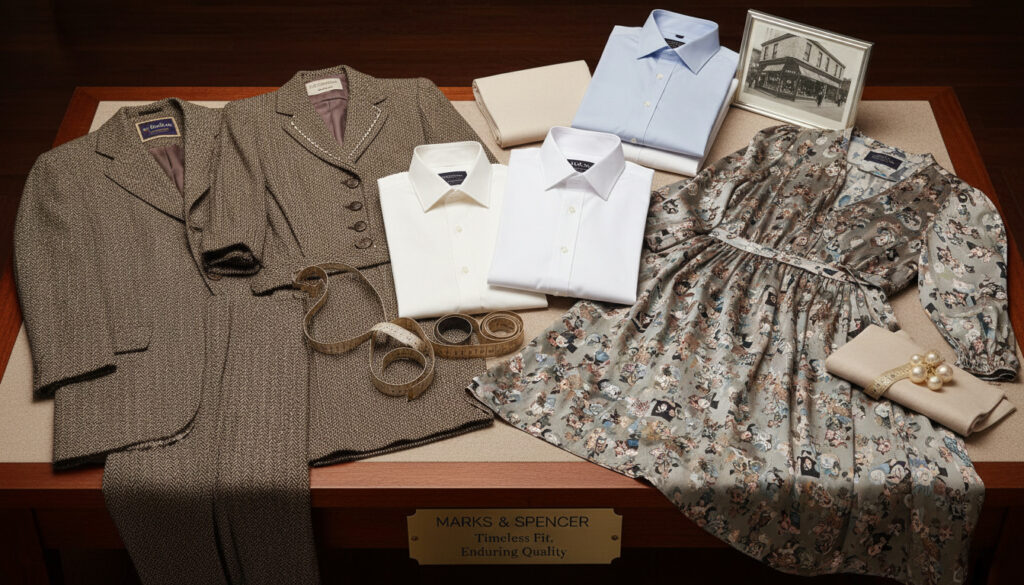
M and S Clothes – Fit, Quality and History Guide
Marks & Spencer stands as one of Britain’s most enduring retail institutions, having clothed generations since 1884. The company built its reputation on accessible quality, pioneering sizing standardization and customer-friendly policies long before modern e-commerce transformed the high street.
Today, M&S operates extensive clothing ranges spanning women’s, men’s, and children’s apparel, balancing heritage craftsmanship with contemporary sustainability mandates. The retailer maintains distinctive house brands while competing against fast-fashion giants and digital-only marketplaces.
The evolution of M&S garments from penny-bazaar origins to present-day collections demonstrates enduring attention to fit accuracy, material quality, environmental commitments, and competitive positioning against rivals like Next and H&M.
What Clothing Ranges and Features Define M&S Today?
- M&S maintains strict own-brand control, sourcing directly from manufacturers to eliminate wholesaler markups
- The Per Una range, created by Next founder George Davies in 2001, remains the brand’s premium womenswear success story
- Historical “Good, Better, Best” tiering system has evolved into contemporary streamlined categories
- Fabric innovation dates to post-WWII synthetic development including Nylon and Terylene
- Size standardization began with the 1957 stocking measurement system
- Plan A sustainability framework governs modern textile sourcing and carbon reduction
- Digital expansion accelerated post-2018 to compete with Amazon’s market dominance
| Attribute | Detail |
|---|---|
| Founded | 1884, Leeds |
| Founder | Michael Marks & Tom Spencer |
| Key Clothing Range | Per Una (Acquired 2004) |
| Premium Line | Autograph (Launched c.2000) |
| Return Policy Origin | 1953 No-quibble exchange |
| Sizing Innovation | 1957 Stocking size system |
| Market Share (Pre-1990s) | 14.3% UK clothing |
| Sustainability Program | Plan A (2007) |
| Recent Investment | £500m (2022-2023) |
| Primary Competitors | Next, H&M, Gap, Matalan |
How Do M&S Clothes Fit and What Quality Standards Apply?
Sizing Accuracy and Historical Context
M&S introduced Britain’s first standardized stocking size system in 1957, establishing early credibility in fit consistency. The 1953 no-quibble return policy emerged specifically because stores initially lacked dressing rooms, forcing the company to guarantee satisfaction without trial.
Fabric Durability and Construction
The retailer built its reputation on “British quality goods” through direct manufacturer relationships rather than wholesale intermediaries. Post-war innovations included pioneering synthetic blends like Nylon and Terylene, developed with dedicated design consultants to ensure performance standards.
Official size guides for women, men, and children are available on regional M&S portals. The company’s historical focus on high-performance textiles addresses easy-care requirements, though specific shrinkage rates for current collections remain undocumented in available materials.
Range-Specific Variations
Quality tiers historically followed “Good, Better, Best” classifications, though modern lines like Per Una and Autograph occupy distinct premium positions. Discontinued ranges including SP Clothing (menswear) and DB07 (David Beckham childrenswear) demonstrate the brand’s willingness to cull underperforming labels.
What Sustainability Commitments Govern M&S Apparel?
Plan A Environmental Framework
Launched in 2007, Plan A constitutes a 100-point initiative targeting carbon reduction, zero landfill waste, and sustainable sourcing. The program expanded in 2008 to include a 5p plastic bag charge that reduced usage by 80% while raising £500,000 for charitable causes, as documented in business analyses.
Ethical Supply Chain Standards
Quality control extends to third-party brand selection, with ethical care remaining central to procurement decisions. Worker welfare standards within supply chains form a core component of the Plan A mandate, alongside commitments to healthier living initiatives for customers.
How Does M&S Position Against Competitors in 2025?
Market Rivalries and Differentiation
M&S competes directly with Next (notably Per Una’s originator), H&M, Gap, Jigsaw, and Matalan, while facing intensifying pressure from Amazon’s digital dominance. The brand’s 14.3% pre-1990s UK clothing market share eroded during the 1990s-2000s before recovering through design-focused investments.
The 1953 exchange policy remains active, allowing returns without interrogation. This approach originally compensated for the absence of fitting rooms and continues to distinguish M&S from stricter high-street competitors.
Strategic Physical and Digital Presence
Between 2022 and 2023, M&S invested £500 million in store infrastructure, closing smaller locations while opening larger flagship sites with broader clothing selections. This physical expansion complements post-2018 digital streamlining efforts to enhance online shopping technology.
CEO Steve Rowe’s 2016 restructuring reduced clothing emphasis in favor of food retail, while recent strategies pivot toward larger format stores. Shoppers should verify current range availability at specific locations via corporate communications.
How Has M&S Clothing Evolution Unfolded Across 140 Years?
- : Michael Marks establishes Leeds penny bazaar with “Don’t ask the price” slogan (source)
- : St. Michael brand introduced under Simon Marks
- : No-quibble exchange-and-return policy implemented for apparel
- : Revolutionary stocking size system standardizes fit measurements
- : St. Michael label discontinued; Autograph premium range launched
- : Per Una womenswear debuts as George Davies joint venture
- : M&S acquires Per Una outright for £125 million (source)
- : Plan A sustainability initiative launches
- : Strategic shift reduces clothing focus prioritizing food retail
- : £500 million store investment program begins
What Facts Are Established Versus Uncertain Regarding M&S Garments?
Verified Information
- Founded 1884; incorporated as Marks & Spencer
- Per Una acquired 2004 for £125 million
- Plan A launched 2007 with 100 commitments
- Return policy originated 1953
- Stocking size system introduced 1957
- Pre-1990s turnover reached £8.2 billion
- 2022-2023 investment totals £500 million
Unclear or Variable Data
- Current specific shrinkage rates for cotton blends
- Real-time promotional schedules and sale calendars
- Exact measurements for curve or petite inclusive ranges
- Live Trustpilot review aggregates
- Contemporary market share percentages
- Annual clothing-specific revenue breakdowns
Why Does M&S Maintain Distinctive British Retail Status?
M&S carved its identity through vertical integration, controlling quality by purchasing directly from manufacturers rather than wholesalers. This model enabled competitive pricing while maintaining hygiene standards enforced through rigorous 1950s staff training programs.
The brand’s social impact extends beyond commerce; the M&S Archive at the University of Leeds preserves 72,000+ items documenting British social history. From post-war synthetic fabric innovations to contemporary ethical sourcing, the retailer reflects evolving national attitudes toward consumption and quality. Those seeking Funny Secret Santa Gifts – Best Budget Office Ideas will find M&S offers complementary accessory ranges alongside its core apparel.
What Do Primary Records Reveal About M&S Clothing Heritage?
“Don’t ask the price, it’s a Penny.”
— Michael Marks, 1884 founding slogan (M&S Corporate History)
“Renowned for British quality goods, fair value, hygiene, and own-brand control via direct manufacturer ties, cutting wholesalers for better prices and oversight.”
— EBSCO Research Starters, Business & Management
What Should Shoppers Remember About M&S Clothes?
Marks & Spencer offers comprehensive own-brand clothing through distinct tiers, from everyday essentials to the premium Per Una and Autograph lines. The retailer’s 140-year heritage manifests in consistent sizing methodologies, the enduring no-quibble return policy, and Plan A sustainability commitments. While specific current promotions remain unverified in available documentation, the brand’s direct-manufacturer model continues to support its reputation for durable, easy-care fabrics. For those exploring British retail traditions beyond fashion, Mary Berry Yorkshire Pudding – Classic Recipe Made Easy represents another cornerstone of domestic quality standards.
Do M&S clothes shrink in the wash?
No specific shrinkage data is documented in current research, though M&S historically emphasized high-performance, easy-care textiles designed to maintain shape. Always follow garment care labels.
What size should I buy at M&S?
M&S provides official size guides for women, men, and children on their website. The brand pioneered standardized sizing since 1957, suggesting charts generally run true to measurements.
Can I return clothing without a receipt?
The 1953 no-quibble exchange policy traditionally allows returns without interrogation, though current terms may require proof of purchase for refunds. Check latest policies at point of sale.
Is Per Una still available at M&S?
Yes. Per Una continues as M&S’s premium womenswear range after its 2004 acquisition. It was notably the only brand spared during the 2010 womenswear audit.
How does M&S quality compare to Next?
Both British retailers emphasize quality, with historical ties—Per Una founder George Davies also created Next. M&S focuses on own-brand control and sustainability via Plan A.
Does M&S use sustainable materials?
Plan A, launched 2007, mandates sustainable sourcing, carbon reduction, and ethical supply chain standards. Third-party brands are selected based on environmental and welfare criteria.
Are there current sales on M&S clothing?
Specific live promotions are not documented in available research. M&S historically emphasized value pricing over discounting, though seasonal sales may occur. Verify current offers on official channels.
More related posts
 Chat GPT Image Generator – Use, Prompts, Pricing & FAQ
 The Summer I Turned Pretty Season 2 – Where to Watch, Episodes and Cast
 What Is Shop Pay – Fast Checkout, Security and UK Guide
 Cast of Asteroid City – Full Actors and Roles Guide
 Is Avocado Good for You – Benefits, Nutrition, Risks
 Idi Amin – Life Atrocities Death and Legacy of Uganda’s Butcher
 Turkish Lira to Pounds – Current Rate and Conversion Guide
 ODEON Luxe Leeds Thorpe Park – Priser, Parkering och Omdömen 2025
